
Service Mesh
In the complex world of microservices and container networking, making sense of all the communications can be daunting. Beyond just connecting services, there's a demand for features like monitoring, secure access control, and encrypted communication. Instead of loading your application with these functionalities, there's a more elegant solution: a service mesh.
What is a Service Mesh?
Think of a service mesh as a dedicated network for your microservices, equipped with its own traffic cops and rules of the road. It's built on the concept of attaching a lightweight network proxy to each service. These proxies intercept and manage the network traffic between services, allowing for sophisticated traffic management, security, and observability without changing the services themselves.
Why Use a Service Mesh?
Complexity Management: As the number of services grows, so does the complexity of managing their interactions. A service mesh handles this complexity externally.
Security: It can automatically encrypt communication between services, managing security certificates and identity verification with minimal effort from developers.
Observability: Service meshes offer insights into how services communicate, including metrics, logging, and tracing, which are crucial for diagnosing problems.
Popular Tools:
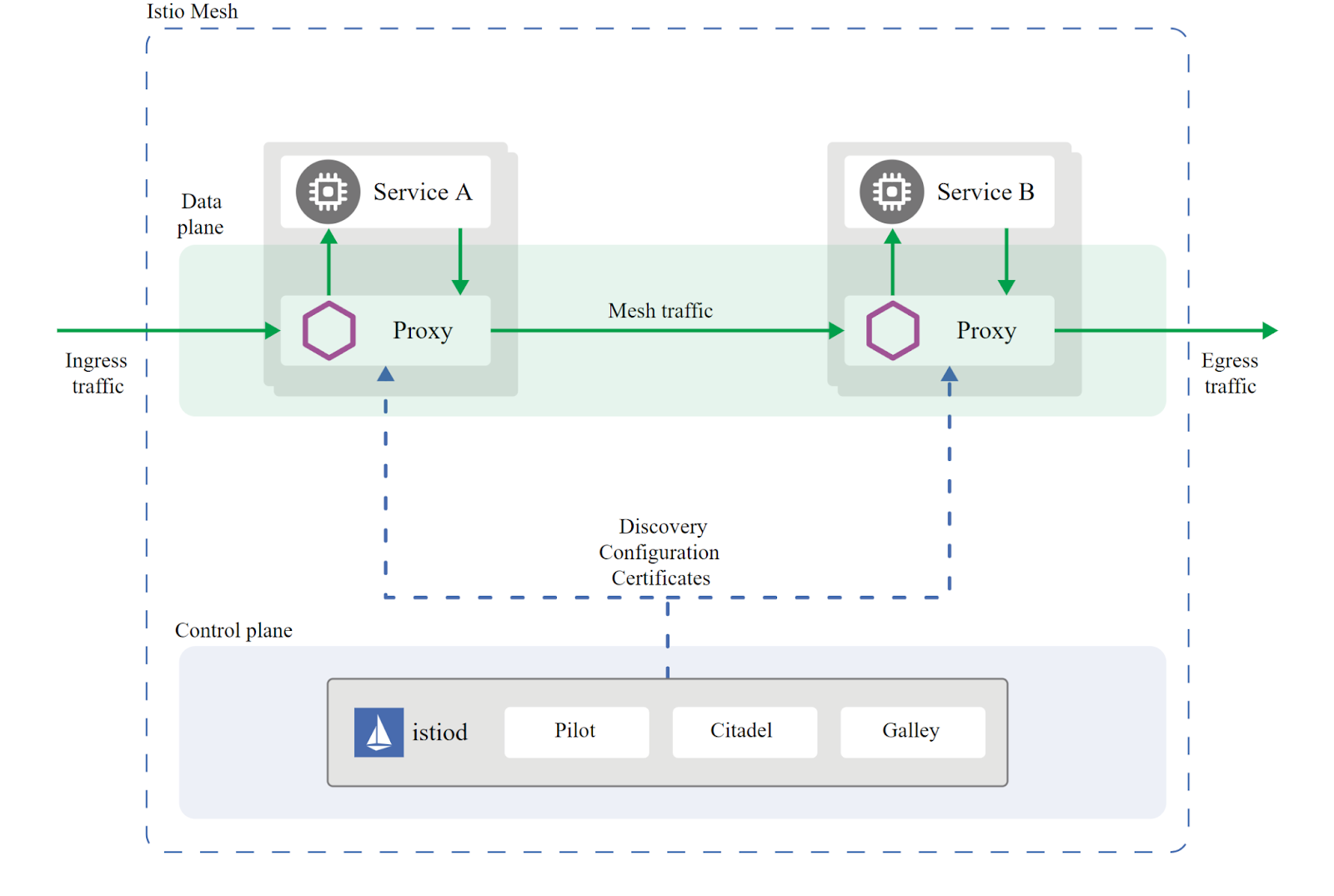
Istio and Linkerd: While there are differences in their implementation, both Istio and Linkerd operate under the same fundamental architecture, providing a layer of proxies (data plane) managed by a central control plane.
How It Works:
Data Plane: This consists of the proxies attached to your services. They enforce the network and security policies, like encrypting data before it's sent to another service.
Control Plane: Here, you define the rules on how services should communicate. Want encryption between Service A and B? Just configure it here, and the proxies make it happen.
Service Mesh Interface (SMI):
To bring some standardization to the diverse world of service meshes, the Service Mesh Interface (SMI) project was introduced. Focused on Kubernetes, SMI aims to define a set of standard specifications for integrating service meshes, ensuring a consistent user experience and making it easier for providers to offer compatible solutions.
In essence, a service mesh abstracts the networking complexities of microservice architectures, providing a powerful, flexible, and secure way to manage service-to-service communication. It's like giving each service its own private assistant to handle the intricacies of network traffic, letting developers focus on building great applications.
Last updated