
GitOps
GitOps is a paradigm that extends Infrastructure as Code (IaC) principles, leveraging Git as a cornerstone for automating infrastructure provisioning and application deployment. It marries the process of infrastructure changes with the reliability and control of version management, harnessing the power of Git for operational and deployment tasks.
Core Principles of GitOps
1. Git as the Single Source of Truth:
Everything from code to configuration, policies, and even network rules lives in Git repositories. This approach ensures consistency, traceability, and accountability for all changes made within the infrastructure and applications.
2. Automated Delivery Process:
Merge or pull requests not only facilitate code review and integration but also trigger automated CI/CD pipelines that apply these changes to the infrastructure, embracing a consistent delivery mechanism for both applications and the environments they run on.
GitOps Mechanisms: Push vs. Pull
Push-based Approach
In a push-based model, changes to the infrastructure are actively deployed by CI/CD tools triggered by actions like commits or merge requests in the Git repository. This approach directly applies changes to the target environment.
Pull-based Approach
The pull-based model relies on an agent within the infrastructure that continuously monitors the Git repository for changes. When discrepancies between the desired state (defined in Git) and the actual state (in the infrastructure) are detected, the agent reconciles these differences, ensuring the infrastructure aligns with the code in Git.
Follow this Blog to understand the difference between Push and Pull based model in easier terms.
Popular GitOps Tools: Flux and ArgoCD
Flux
Built with the GitOps Toolkit, Flux offers a comprehensive set of APIs and controllers for implementing GitOps practices. It enables customizations and extensions for diverse operational needs.
Designed as a Kubernetes controller, ArgoCD exemplifies the pull-based GitOps model, maintaining the desired state of applications and infrastructure as defined in Git repositories.
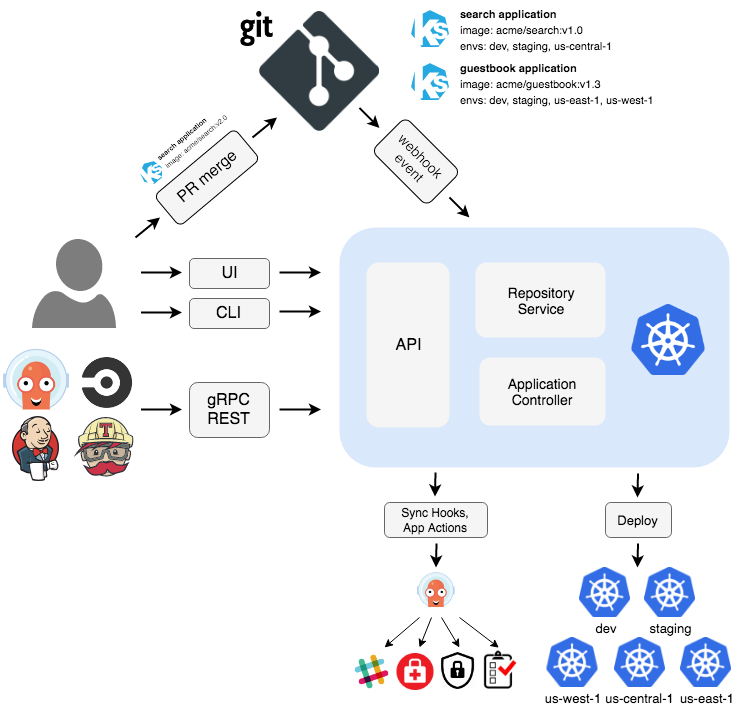
ArgoCD Architecture: Demonstrates the GitOps implementation, managing and synchronizing the state of Kubernetes resources based on Git repositories.
Why Kubernetes is Ideal for GitOps
Kubernetes' declarative nature and comprehensive API make it an excellent fit for GitOps. It inherently supports the GitOps model by applying desired states defined in Git to the actual infrastructure, mirroring the pull-based approach within its operational design.
Learning GitOps
For those interested in diving deeper into GitOps and learning how to leverage tools like ArgoCD and Flux, exploring educational resources such as "Introduction To GitOps (LFS169)" can offer practical insights and hands-on experience.
Last updated